On Line Direction

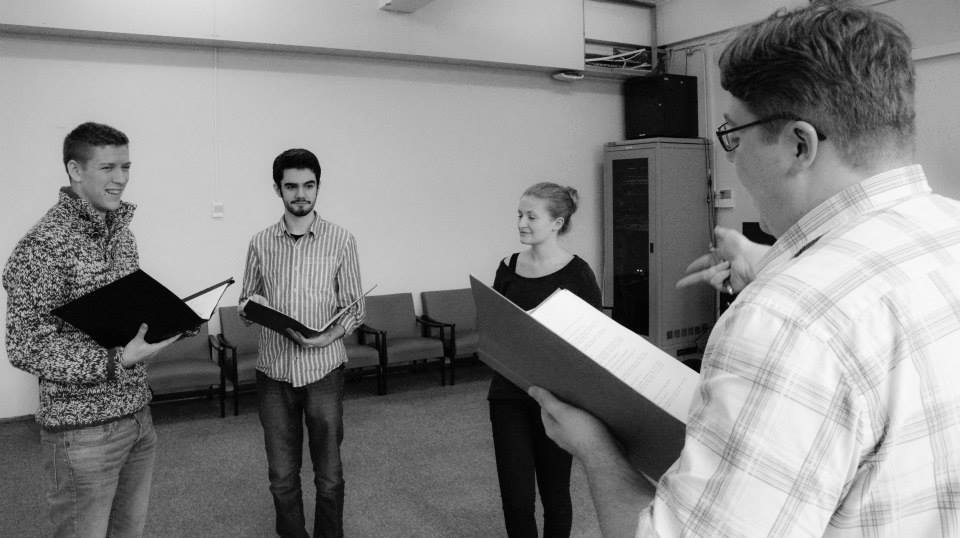
The last two theatrical productions couldn’t have come from more different backgrounds: one had a lot of money behind it and one didn’t. They were both inventive and original, they both entertained, they both had live music, and to an extent, singing.* But the one with the money left me substantially disappointed, where the one without left me very happy indeed.
BEFORE YOU CLICK AWAY, I’m not about to jump on some “indie bandwagon” or suggest that Pig (Silent Uproar Productions, New Diorama Theatre, 2015) was better than Dusty (Five Foot 2 Blonde, Charing Cross Theatre, 2015) because it had less money. That’s not what I’m saying. God knows, the West End and its finance produce some masterpieces. I would also like to preface by saying that I was not present at the rehearsal process of either productions, so some of the examples I use here should be treated as hypothetical. But the contrast in resources that these two productions have places an interesting question on something I’ve wanted to talk about for a while.
I call it Line Direction because that makes sense to me. It’s the way the actor’s lines are directed.
Put simply, it’s the art of making the lines sound believable – how a person in any given situation might say them. In my opinion it’s probably the most important thing a director does. So why is it often maligned?
Bad line direction is often mistaken for bad acting. I can see the argument here. “It’s not the director’s job to say the line, that’s the actor’s job. So if you have a problem with how the line was said, your problem is with the actor, not the director.” But if you didn’t like how a space was used in a production, or the way a blocking worked, you don’t blame the theatre architect, you blame the director. If for instance, you don’t like that a particular speech has been moved from its expected position (I am thinking, of course, of any given production of Hamlet), you don’t blame the writer, you blame the director. I have often disagreed with the idea that the actor is simply a tool, a mannequin for a director’s vision, and I do think that an actor should be consulted and collaborated with, but if they say a line wrong in rehearsal, it’s the director’s job to fix it, just as much as he or she may have vetted a script or blocked a scene. So: if the acting is bad, my first port of call is always the director. [EDIT: The practicalities of this are important and are discussed in the comments.]
I would like to point out that this does not mean that I think “bad actors” do not exist. Sometimes, people just don’t get it. I’ve worked with these people and it can be incredibly frustrating, but surely if you have resources like Dusty does, would you not re-cast? If that’s impossible, it is important to keep your cool and work with what you have. For hours, on one line. What you shouldn’t do is give up, let your actor go out there and have her eviscerated by critics who don’t think before they write.
The second objection I can see arising is that my problems are merely opinion-based – that the way a line was said was acceptable and I just think it was wrong. I will admit, that sometimes there are many legitimate ways to read a sentence that completely change the meaning, and that many an interesting production has been based on this premise alone. However, sometimes a delivery is just wrong.
Let us consider the line “Not if I can help it.” It is a complicated line, that requires a lot of context to understand. How you will have just read it is likely to be your ‘default’, if you like. Perhaps, the way you think this sentence is most commonly uttered. But if we change the emphasis, it can refer to all sorts of things. Let’s just make a single word the focus of the sentence, so that things don’t get too muddy too quickly, and roll through some possibilities. Hold on to your hat, Mr Jones, things might get a little dense here. To be clear – the word in bold has the emphasis.
- “Not if I can help it.” – A character is resolving to intervene in a given situation.
2. “Not if I can help it.” – A character has resolved to intervene in the situation, but he is unsure if he can do anything.
These are the two most common variations in this situation. The only context that separates them is the mood of the character – the former usually sounds more determined or angry, whereas the latter usually sounds more doubtful. Of course this can change with inflection, and they are often combined. Now things get a bit more context heavy:
3. “Not if I can help it.” – A character responds to a naysayer, telling them that intervention won’t lead to whatever they were worried about.
4. “Not if I can help it.” – A character responds with certainty to a naysayer, in order to rally and inspire.
The subtlety between these two lies in the character – in their certainty, their desire to convince others. The former, for instance, might suit a situation where the character was already attempting to intervene, whereas 4 suits a situation where they are asking permission to intervene. While it seems very specific, the reading of number 3 might also be used to apply some subtext to a more common situation by suggesting the character has internal conflict about his actions, and is responding perhaps to an inner monologue. Now the last two are much more rare:
5. “Not if I can help it.” – A character is making clear exactly which side of the conflict he’s intervening on.
6. “Not if I can help it.” – A character is determined to help, but is doubtful of his chances in helping.
The reason these sound weird when you say them out loud is that people don’t say them out loud. They might be combined with the others, but more often than not a combination of 1 and 2 will replace either of these and sound much better. The point is that if you were directing and your actor came out with 5, you might stop them and try to replace that 5 with a 1 & 2 combo, and that is what I mean by line direction.
If you want an excellent example of line direction, go back to Yes, Prime Minister. Not only did it have (terrifyingly) understandable characters, but it went two steps further and used its line direction to get a laugh out of the subtext of a line. This is what is commonly known as innuendo**. So let’s bring Humphrey Appleby into this.
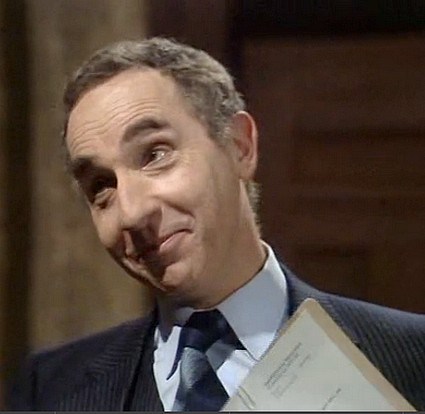
Sir Humphrey is a master of telling exact truths, and some might say of lying by omission, through not only the words that he uses but the emphasis and inflection he gives those words. If he were to slip up, the whole government of the United Kingdom might be at stake! Precision is important. In the above clip, Bernard’s inflection on “He accepted the fact that there were no legal grounds for suppression…” clearly tells us that he was about to go on and say “but…” However, when Sir Humphrey tells him back the exact same words, the meaning is completely changed, a fact that is not only crucial for the plot and the character motivations of Bernard, but also reads as a joke. If he had said the line back to Bernard with the same emphasis and inflection, all three of these would have been ruined and you might be saying that Nigel Hawthorne is not a good comic actor.
This is great acting, yes. But this is also great line direction.
Dusty had great vision. It had great resources, good choreography and interesting visual story-telling. So I know at some point, a director was in the room paying attention. So how did they let the actors go out on the stage and deliver their lines in what was often a stilted and jarring way? You can’t just put this down to “bad acting”; if the actors weren’t hitting marks or were doing the dances wrong, the director would want that fixed before a performance. Pig not only had all the vision and spatial excellence that Dusty did, but it also had brilliant line direction. The result is a better play, with believable characters.
Strip away the West End budget, the set, the music. Strip away the stage, if you like. Just give me an actor and a script. You still need a director. What is there to direct? Lines, my dear Watson. Lines.
*As in, one of them had very little singing, but it did have two people screaming “fuck the Police” along to a track so…
**Which is not all to do with sex, you filth, but merely means communicating a sense not usually associated with a referent. If you know what I mean.
 Leo West
I disagree completely I’m afraid. I know there are some directors out there who want to micromanage every facet of a performance, but I have never seen a good production come from it.
How do you make the lines believable? You, personally, as the director, cannot. You are not the body and mind that deliver the lines. You deliver your vision to the actors, you foster complete honesty, you allow the actors to play and explore every facet of the text, to fail and be vulnerable, you string together your vision and their interpretations of that and you guide everyone towards a cohesive piece. The best directors can bring forth great truth from their actors, but never mould them into a particular shape.
In this way, every performance can be spontaneous, the actor can make new discoveries each time, even after the blocking has been set, and every production, even with you directing, will be different because you are working with the actor as an interactive tool, not imposing your will upon a blank canvas.
The best theatre I have ever seen made me feel as though anything could happen, at any moment. It is alive with risk. And the times when I have felt at my best as an actor are when the director has given me the inspiration, guidance and space to explore my own choices. It deadens the actor to be told “no, stand in THAT spot, and be really angry when you tell him it’s over”. The director is not and cannot ever be the actor, he can only guide, question, and connect actors. This is not to say that the director cannot be absolutely detailed in his vision, but he will work with the actor to achieve that, not upon them.
To use your example: if Man A is delivering the line “Not if I can help it”, and the audience does not believe him, it won’t be because of his vocal inflections. It’ll be because the line hasn’t come from a place of truth – Man A and the director haven’t yet reached a place of honesty from which that line can come repeatedly. The line, somewhere, has become disconnected from the human, perhaps the actor has lost focus, or is clouded by ego, or has not properly developed the internal motivation for the line being spoken.
It is of course possible that the director has done all he or she can, and the actor for whatever reason is unable or unwilling to commit. It may be that the actor wants to understand but has not been given the right tools by his or her director. It might be that the writing is unsophisticated so the line jars. It could be for a whole range of reasons, but I can promise you with no uncertainty – it won’t be for lack of specific line direction.
“people don’t say them out loud”,
– this is so prescriptive! YOU might not, the people you associate with might have never done so in front of you, but it absolutely depends on the character, and the context. For example, someone in a fit of rage might very well spit out every word, or choose a random word to emphasise because that’s the point at which they see red. Perhaps this character is not your typical well-spoken englishman and their inflections are different (think: every character christopher walked has ever played), Perhaps this character is shy and sounding like a human in front of other people is hard for them. Perhaps that’s just an idiosyncrasy of that character!
“The point is that if you were directing and your actor came out with 5, you might stop them and try to replace that 5 with a 1 & 2 combo, and that is what I mean by line direction.”
I’m glad you at least went with ‘might’. My point is that perhaps there is a rhyme and reason to why the actor has chosen to speak the line that way, and instead of telling them it should be different, perhaps ask them about their choices, understand them – it could of course be that they’ve misunderstood the context of the line, or that they’re not feeling the truth of it, but it might very well be that it’s a little bit of gold dust which with a bit of nurturing could be something really interesting that make the audience sit up out of their predictability heads. And if you really think it should be your way, how about asking them to try it as opposed to setting it in stone? for all you know your 1/2 combo might not work on their lips and with their character.
In the case of Sir Humphrey, the line is funny because of the motivations behind it and the consequences relating to it. It is this which has formulated the delivery of the line, and it would be nowhere near as funny if the line had been directed a la carbon copy. Now I appreciate there might only be one way to deliver that line – but if the actor is true to the scene he will find it, and if he has not found it, it isn’t the line that’s wrong, but the motivation behind it.
Imagine if we tried to direct Stewart Lee or Michael Crawford in this manner – both very funny performers, both with very particular idiosyncrasies in their deliveries, borne not of analysis but of irony and character. “No – Stewart, nobody talks like that!” – but he does, and it feels like it shouldn’t work, but it does!
Well written dialogue allows a whole world of subtext and possibility – often more powerful than the spoken line itself. if you as a director begin to manhandle the line, you could very well be trying to screw the wrong lid upon a beautifully sculpted inner world bubbling underneath. You can only work with what the actor gives you, and if that does not work – and at this point I do agree with you – then recast immediately, because you’ll both be wasting each other’s time.
In reference to your question regarding the link between funding and quality:
Good theatre is all about risk. any play with huge resources thrown at it has to either have proven itself (either by track record, a tried and tested formula, or a big name to fall back on) or play it safe, which, as we know, is the death of good drama. This is where micromanagers come in, because they want everything to be exactly as it was three years ago when the audience laughed at the joke for the first time. “Tell it that way!” they say, and once dissected and put back together, the creature is thoroughly dead.
when you have less money at stake, you can afford to fail, and failing is exactly what you need to make dynamic and dramatically tense performances.
More risk-taking in huge institutions like the West End could seriously improve the quality of some material – however it is actually less the domain of the producers, but of the audiences. It’s a vicious cycle, because audiences who are paying huge amounts for a night at the theatre want an absolutely risk-free fail-proof show for their buck (understandably), and in order to provide that, the theatres spend huge amounts of money on making sure that that’s exactly what they get – which in turn raises the dollar and so on, people end up paying top dollar for shows which are safe and predictable and don’t make them at all uncomfortable or challenged – and that’s fine, but that’s not the kind of theatre most artists wants to create. There are exceptions, of course, I’m just speaking in general here.
On Dusty (though I haven’t seen it) I can agree with you that the problem would seem to be direction, or lack of it. When actors become wooden, it is usually for lack of a good director to inspire spontaneity. The actor and director are completely symbiotic – one cannot be their best without the other.
…And with that, I take my second breath, and wonder where the hell an hour went!
Amy x
Amy, thanks for taking the time! I’m glad you did, because I really don’t think we disagree as much as you think we do.
I perhaps spent so long trying to explain what I meant by the concept that I didn’t go at all into the practise of how it should be done. I think I said in the blog that I disagree myself with the idea that an actor is there to be a mannequin for the director, and I do. Actors are there to be collaborated with and consulting them can indeed lead to moments of inspiration that might not have otherwise been attainable.
But it is still the director’s job, if a line is jarring, to fix it. This is of course, exactly what you are saying. I don’t mean she should fix it parrot-fashion, shouting the line back at them ’till they get it right. It would be better to discuss the scene, the character, what’s going on, until the delivery clicks. This method is better for everyone and is the only one I use, as long as I can help it. So I might say that line direction involves pinpointing when an actor isn’t being true and helping them to get there.
The problem is that this is so context heavy that it’s difficult to discuss in hard and fast rules, but we’ll try anyway! But suffice it to say that there can be the incorrect way to say things and it’s a shame a lot of directors don’t seem to want to help their actors with that.
As for risk and theatre, I wrote a whole other post about why Dusty failed. It wasn’t not taking risks. That show takes a lot of risks, and some of them are ill-advised!
Thanks for taking everything in the spirit in which it was intended!
I think we do agree to a certain extent – but I still don’t think there is ever an ‘incorrect’ way to say a line – only a dishonest one! And yes, it is a shame when you see that a director has spent so much time and effort on the other facets of a show and failed to go into any depth with the actors. I still maintain though that it’s never the lines that are a problem, it is always the intent. I’ve seen quite a few actors who are well regarded get stuck in a cycle of patterns with their line readings – they become quite voice-dependent because they have latched onto a particular style of speech and intonation that has worked for them in the past, and sounds realistic – that’s where the danger is in it because they then feel that’s all they have to do. Speaking a line is the culmination of thousands of tiny choices and moments in the character’s mind, so I think my main point was – if the line doesn’t feel right, don’t change the line, change the build up, change the reason it’s being said, and can be said no other way, the line will fix itself.
I’ll have to have a read of your Dusty post – no essays this time, promise!
xxxxx