D&D: Painting Impressions

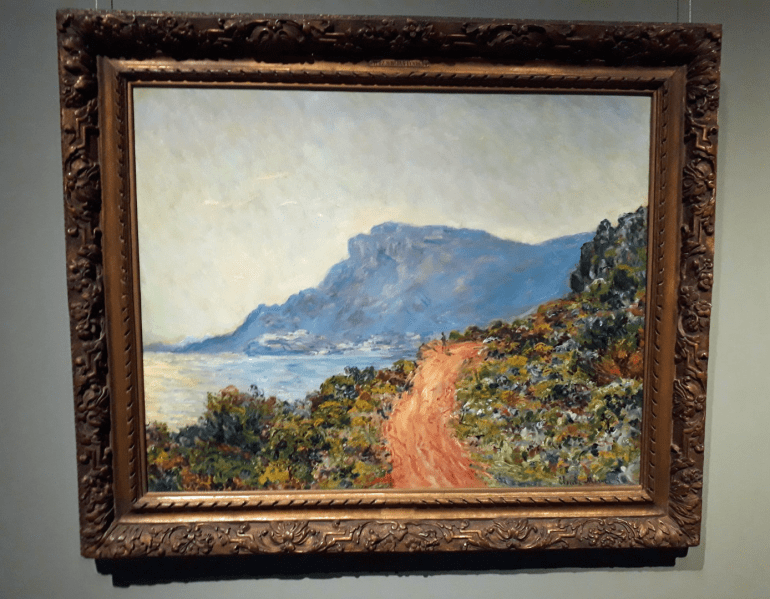
This painting is gorgeous. The atmosphere it creates is palpable. It draws the eye down its road and it makes the viewer ask questions. Who is the person up ahead? Are they going to pass us or are they looking out across the bay? Perhaps they are straining out to see a boat or just looking towards the town on the other side of the water.
Monet is a master of impressionism of course, and in a fit of aloofness and enigma recently, I posted a photo of this painting with the caption “this is how you DM.” What I was trying to grasp at was that, in my opinion, it does as much world-building and storytelling as a more detailed, hyper-realistic painting.
Any art form is finite, and every session of a table top game you play will also be finite. Whether you play for two hours a week, or massive eight hour sessions every day over a holiday, the game will finish. Inevitable, right? There is a finite number of words you can say in that time, so there are only so many words a game will be, and those words have to be divided between the GM and the players.* Then you’ve got to account for how many of those words will be for combat and combat descriptions, how many will be jokes and how many will be dialogue. All of this will vary depending on your style and your players, but the point I’m sure I’ve got across by now is that there is only limited space for world-building. Those limited words have to tease potentially unlimited situations.**
So how do we pick what impressions to paint with our words? If there’s a story you really want to tell, you can make it seep into the setting itself by keeping it in mind when you’re building.
Strong world-building occupies all the real estate it can. Yes, you have to give over words to battle decisions, but if the encounter is built with the context of the world in mind, then these descriptions can lend themselves to reinforcing whatever story you are telling. For example, a battle on a snowy mountain cliff gives ample opportunity to ram home the setting. Quite often I see other game masters painting a wonderful picture right up until the combat starts, and then they let the battle map do all the world-building for them. Even if you’ve shelled out for the incredibly crafted mountain side model setting and appropriate minis for everything in the battle, you can give an environmental or story detail in with the battle descriptions. Instead of leaving it at “24 damage? Nice,” you could add a detail about the character’s fingers struggling to hold on to the sword with cold as they land the blow. A different detail for each character and soon all the players are assuming all the details are happening to their character too.
In order to make the world feel alive, remember the impressions you paint, and make them interact with each other. If you mentioned the character’s fingers were numb on that mountainside, mention them going blue if they go further up the mountain, or mention the moment the character starts to get the feeling back as they descend into warmer weather.
A piece of advice I see a lot for building NPCs is to assign them ‘that one detail that the players will remember’, like missing fingers, a scar or a lisp. Impressionistic world-building does this with almost everything. A city might have a regimented cleanliness to it, and a district within that city smell of fish. How do those two facts work together? There’s probably a gutter, or a well-funded refuse collection service, or maybe something has gone wrong. Already these two simple details are spinning themselves out into a story. Add into that district a slightly ramshackle warehouse, and into that warehouse put damp and you can start to layer on the life into the place. Just remember or note the details!
Two major advantages of this style is the amount of improvisation it allows the GM to do if and when they need to manipulate the story, as well as the amount of freedom it affords the players to add to the scene, with the GM’s permission. For example, if we decided that the above fishing district had a well-funded refuse collection service, a player might at any time ask “Is one of the fish-head-collectors about?” Of course they are! That doesn’t mean they’ll necessarily be helpful or useful, but they’re there.
This is the relationship I feel I have with La Corniche. My mind wants to fill in the details of the town in the distance, wants to tell a story with the person on the road up ahead, and if I go away and come back later, those details can shift and the story can change.
‘Less is more’ is an adage that gets said a lot, but I think here a better approach is to consider that ‘more is not more’. You’ve got to add some details to give the players something to hook on to. However, unless it’s vital to your plot, don’t spend a thousand words describing the history of a monarchy as it is carved into a gate. I’m looking at you, Tolkien.
*According to this research from 6 minutes, an approximated average speaking rate for TED Talks is 163 words per minute. Divided equally between one GM and four players, that’s just over 30 words per minute each, which is just under 2000 words an hour each, not accounting for thinking time, laughter, dramatic pauses and dice maths. That’s not an awful lot.
**There is an assumed premise here that a good game is a sandbox-type one which allows everyone to speak equally, is varied, has laughter and dice rolling. Not all the GMs I’ve met agree with this.
 Leo West