Nerd Is Love

Ah, Netflix. The great Procrastinator.
Of course, it would be easy to say that watching a great movie or documentary is an excellent use of your time. It could be life changing. Why does it have to be procrastination? The thing with Netflix, as you will know if you have access to it, is that the sheer choice of material to watch is sometimes paralysing. You will sit, scrolling through all the little icons of art from shows you could watch, pausing occasionally to give a good rating to something you already have watched, but never actually watching anything. So you sit, procrastinating over what to procrastinate with. It is truly a perfection in wasting one’s time.
There I was one morning then, perfectly wasting my time, when one of the icons caught my eye. The documentary Bronies, focussing on the eponymous ‘phenomenon’ of adult male fans of the show My Little Pony: Friendship Is Magic. I had heard a lot about the documentary already through an interview with the presenter, John de Lancie, and I was curious. I like to think of myself as an open-minded leftie, and I understood the potential for interest, but I found myself sceptical that I myself could ever be into My Little Pony.
Which is of course what John de Lancie (whose connection to the project is professional, as the character of Discord, the bad guy) and most of the other subjects of the film said. Over the course of 90 minutes, we see abuse and acceptance, disbelievers converted and everyone having a grand old time at a convention meeting Mr. de Lancie. Unfortunately I didn’t feel that it did a good job of making its case. I was a receptive enough audient – I was entirely expecting to merely spend an easy hour and a half having my leftiness coddled by a heartwarming, inspirational story. Instead, Bronies felt all at once defensive, like it was anticipating the viewer to be hostile going in, and passive, like it found that it had nothing to say after four or five minutes. It felt like a film made by a community for themselves. It fails in being educative and interesting, and I ended up watching to the end, not for the narrative, nor for the information, but more to say that I had done it.
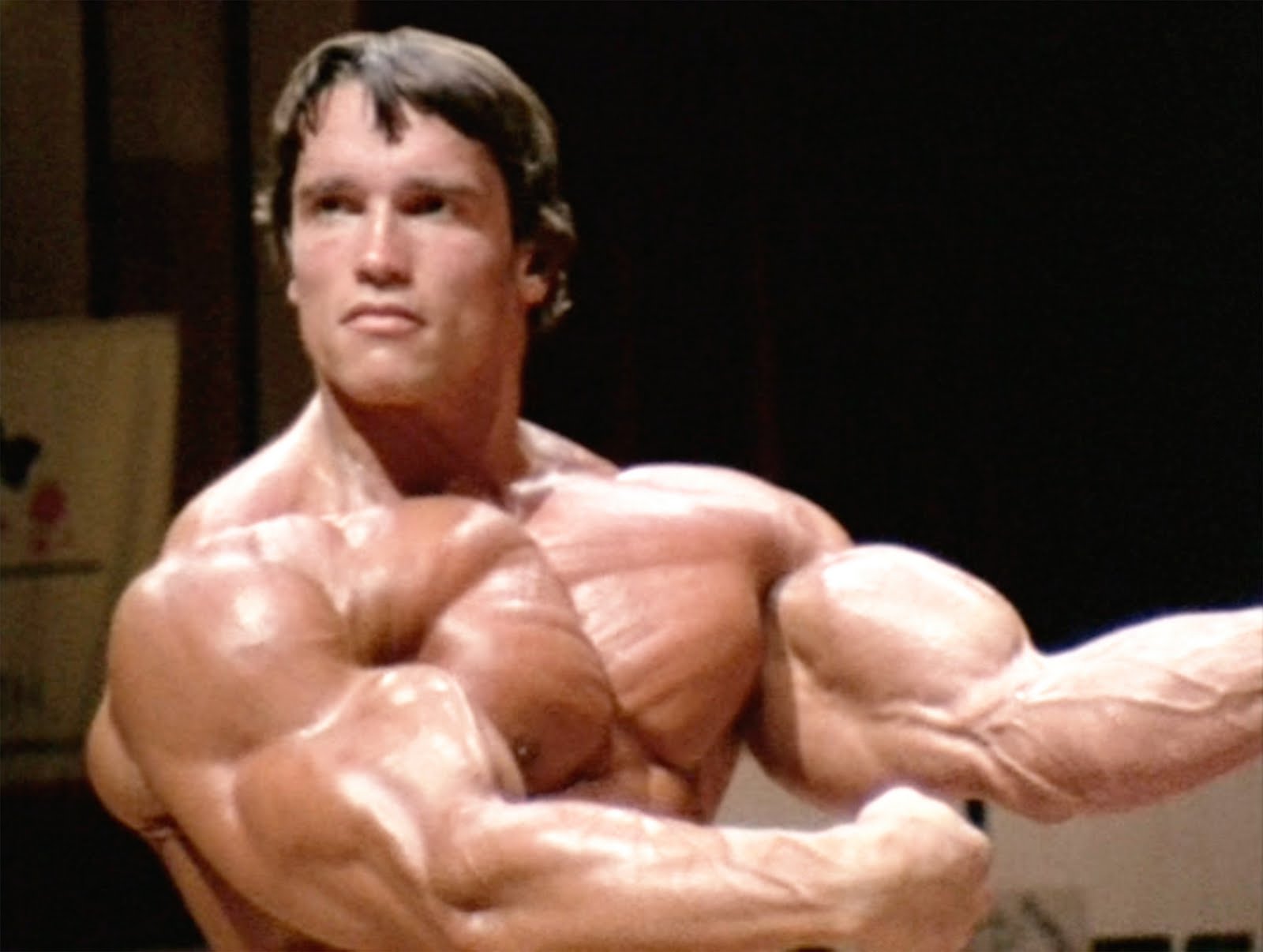
I was left wanting satisfaction. I had set out to watch an engaging and enlightening documentary, and I would not be denied. So instead, I turned to the 1977 film Pumping Iron, featuring (starring, really) Arnold Schwarzenegger, pictured above, which examined the lives of the competitors for the title of Mr. Olympia, the world’s most prestigious body-building competition.
This was much better. It had almost the exact opposite effect to Bronies: it was stark, unforgiving and left me with a picture of Arnie that was not altogether good. He was dedicated, yes. He was intelligent. He was also rude, obnoxious and manipulative. His confidence smacked more of arrogance. I had to keep watching. The narrative gripped me like a good sports film; I had to see who won.* The film was shot well. The cinematography made 85 minutes of lifting weights and posing fascinating. The narration was rare, unobtrusive and well delivered. Crucially, Pumping Iron felt neutral. It allowed the individuals and the community who were the subjects show tell the story, and this left you with moments both uplifting and grotesque.
But watching these films back to back, similarities became apparent between the two communities. Members of both communities often had the same challenges with their parents. They were filled with individuals who were otherwise antisocial; like with the Bronies at the Ponies convention, the body-builders came alive in the gym. Both communities had their own language, of course, that the uninitiated would find it difficult to follow. The crux is that both communities are built on the love of their obsession. The Bronie eyeing up a plush Ponies doll has the same fire in his iris that Arnie does when he announces that he needs another half inch on his left deltoid.
So while these two documentaries might seem an unlikely double bill, they work well together to remind that nerds and geeks don’t just come in all shapes and sizes, but that they are almost literally everyone. Everyone needs an interest, and everyone’s a geek for something, from football to baseball, from body-building to computer building, from Star Trek to EastEnders. What this leaves me wondering is why some geekdoms seem more generally accepted than others.
* SPOLIER ALERT: It was Arnie.
 Leo West