What You Will

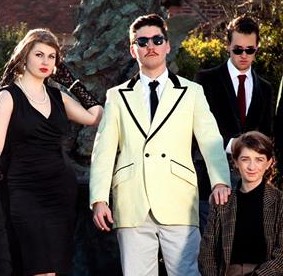
Another Shakespeare comedy – another RSC Open Stage. On Thursday 15th, I went to Stratfod-upon-Avon Fringe venue The Bear Pit to see the first production from The Chrysalis Collective: Twelfth Night. It turned out to be a delightful end to three consecutive nights of theatre.
Unusual interpretations of Shakespeare’s work are not only commonplace, but they are almost a niche competitive market of their own. Directors can latch on to a vision that might spring from a certain turn of phrase, or a reading of a particular scene. Unfortunately, when it comes to applying that to the entire script, and then standing that vision up on stage, the results can be very hit and miss. This is true whether you’re the RSC or an amateur level. I saw a production of Julius Caesar at the Courtyard that just didn’t work for me at all. Happily, this twist on the classic mistaken identity story, directed by Christa Harris, was nothing short of slick, satisfying and entertaining.
The show was based in 1957, and the cool fashions and sensibilities that based it there seemed to fit the text so well that you might have thought it was Shakespeare’s intentions. This speaks, in my experience, to careful editing and arranging of the text, which Harris undertook herself. It was an excellent job; there was one “draw your sword”, where there was no sword apparent, but that is a) a particular bugbear of mine and b) almost inevitable unless one is prepared to throw metre out the window. The real surprise was that Harris directed so that Olivia (the glamours Lucy Lee) discovers that Viola (Woody Allen – uh, I mean, Phoebe Brown)* is a woman early on. Usually, she falls in love with Viola as a man, but the sudden awakening of homosexual feelings within herself fitted Olivia’s speeches just as well, and was a fresh and unexpected look at the main arc. I’ve also never seen a Feste so enamoured of Maria, but thanks to text-less acting (namely, the mouthing of “I know, right?!” at the right moment), nothing seemed out of place.
However, the main thing anyone will walk away from this production remembering is the music.
The simple but highly effective scaffold set (which was complimented by efficient use of moveables) held up a band, who, populated by members of the cast, would play ’50s style rock as incidental, as set piece songs and as interval entertainment.** Composed by Hal Gellar (who also played Antonio and lead guitar in the band), the ’50s music wrapped perfectly around Shakespeare’s songs. They were engaging and felt authentic. They were good songs. This should be seen as a real triumph; it’s all too easy for songs in Shakespeare plays to be bland or even boring. More often than not, they are mostly cut or replaced from productions. The band, consisting of William Pasterfield (who also played the Duke Orsino, his famous “If music be the food of love,” line interspersed by his manic drumming), Hal Gellar, Calum Mercer and Daniel O’Mahony, were a constant joy to listen to, and gave a very tight performance. They were often joined vocally by Chazz Readhead (Feste) and once by Charlie Reilly (Maria), who closed the show with a rendition of “Why Do Fools Fall In Love”, which the audience happily swayed along to. It is of course, the perfect message to end this show, and I wouldn’t be surprised if the song helped form the vision of the show. Crucially, due to mixing or iron larynxes, the band rarely seemed to drown out the singers on the floor, who were microphone-less.
What I’m trying to get across here is what an amazingly good time this production was. From blistering wordplay to amusing slapstick, there wasn’t a moment I didn’t enjoy. On top of that, the cast seemed to be having a whale of a time, each of them throwing themselves into their roles with real mastery of the text. It’s difficult to pick any individual that shone out, because the whole cast was smooth, talented and, most importantly, funny.
Once again, theatre that proves that you don’t need a staggering budget to produce staggeringly good entertainment. Go see it if you can. It runs until… tomorrow. Good luck.
Entertainment – 9 Three hours of joy.
Effort – 8 Depends on one’s proximity to Stratford, of course, but once you;re in there, even those who shun Shakespeare should follow the story.
Expense – 8 £10 full price. Almost every seat in the house is worth that.
Endurance – 6 Standard ‘6’ for an evening’s entertainment.
EQUALS – 7.75 A highly recommended show, and a group of talented people to look out for.
*Phoebe Brown’s Woody Allen impression was really spot on, especially in the scenes with Olivia. This is despite the fact that she denies she was doing one.
**One of the best intervals I’ve ever enjoyed.
 Leo West